
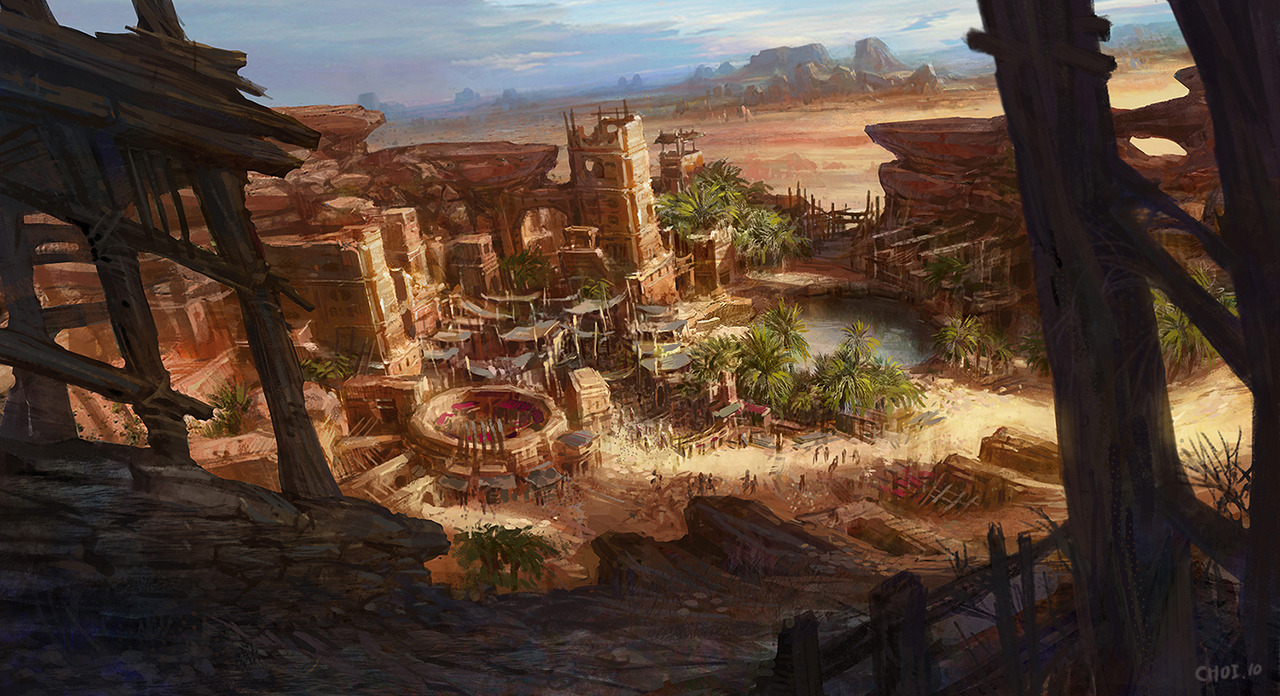
Session 0: The Third Well & the Silent Aquifer
Pathfinder 1e campaign in the Crystal Desert (Guild Wars 2 inspired). Start at Level 9.
Premise
You arrive at a caravan town that lives or dies by an ancient aquifer system. Once a year the water returns for a brief season—then the wells go dry for months. This year, the dry season is worse than anyone remembers: cisterns smashed, granaries raided, and a plague of flies and locusts thick enough to change how people breathe.
The town leadership has one plan left: reopen the ancient machinery beneath the sands. The entrance lies in a dry public pool, sealed by a massive drain-plate meant for maintenance crews that no longer exist. You will descend into forgotten tunnels, dead caverns, and systems that still behave like someone is in charge— even if no living hands have touched them in ages.
Tone & Themes
- Ancient systems beneath the sands: infrastructure older than memory, still running in fragments.
- Ecology of ruin: creatures adapted to maintenance shafts, sealed crevices, and the byproducts of undeath.
- Logistics & survival: rope, water, light, and time matter as much as swords.
- History as argument: what the records say vs what people lived (and what the dead insist is still true).
- Uneasy civilization underground: not all undead are hostile—and not all “order” is benevolent.
Campaign Difficulty & Failure
This campaign is tuned to challenge experienced Pathfinder players. Encounters will not always be fair fights, and the environment will be a major opponent. However, a party wipe does not automatically end the campaign.
If the party wipes: rescuers from the nearest settlement (or local good samaritans) may recover you—alive—but they will prioritize lives over gear. Some items may be lost, damaged, or taken. You may choose to mount a recovery expedition to reclaim what can be found or tracked down.
(GM note: we’ll use a clear, consistent roll-by-category system for gear loss; recovery missions are always an option.)
Starting Level & Party Expectations
- Start level: 9
- Party size: 4 PCs (plus 1–2 recurring NPC companions tied to the town’s politics)
- Optimization: build strong characters—this campaign expects competence. Just avoid infinite loops / trivializing exploits.
- Team play: bring at least one way to handle mobility, darkness, and battlefield control.
- Social play matters: diplomacy and investigation can change the dungeon’s shape and the town’s survival.
The Town at the Table (Key NPCs)
- Maresh of the Third Well — Amirate Steward / Oasis Warden, “Keeper of the Seal.”
- Rhazek — Charr Captain of the Guard (name TBD), blunt, practical, outnumbered.
- Nahla — Administrator of Granary and Cisterns, running the town’s survival math.
- Zalef ir-Qadir al-Sahra — Merchant Prince, scholar-swordsman, not a saint.
- Hekira — Awakened servant of Zalef’s family for generations; ranger-like, quietly lethal.
Character Options & Fit
Crystal Desert is multicultural and dangerous. Humans are common, but so are travelers and mercenaries from elsewhere. Charr, sylvari, asura, and norn can exist as outsiders, envoys, or “this is a long story” wanderers. Awakened characters are possible with GM approval, but should have a clear reason they are not bound to local stultified undead patterns.
Recommended character hooks
- Caravan veteran: you’ve done desert routes and know what “dry season” really means.
- Relic scholar / engineer: you obsess over old systems, maps, and infrastructure.
- Mercenary with a code: you’re here for pay, but you don’t abandon civilians.
- Debt & obligation: you owe the town, the merchant house, or the steward.
- Enemy of the locust-cult: you’ve seen insect-worship or corruption before.
Useful competencies (not required, but you’ll feel them)
- Climb / mobility tricks
- Darkvision or reliable light
- Ways to handle poison, disease, swarms, and fatigue
- Knowledge (engineering/history/religion/planes) for “ancient systems” problems
- At least one social specialist
Session 1 Begins Here
- Council meeting in a candlelit sandstone chamber: the town explains the crisis.
- Marketplace: last chance to outfit and gather rumors.
- The dry pool and the great drain plate: entry to the aquifer maintenance system.
- Descent into the dry well bed: the first sign that the ruins are not empty.
The desert above is harsh. The world below is older—and it reacts to intrusion.