
Understanding Finite State Transducers (FSTs)
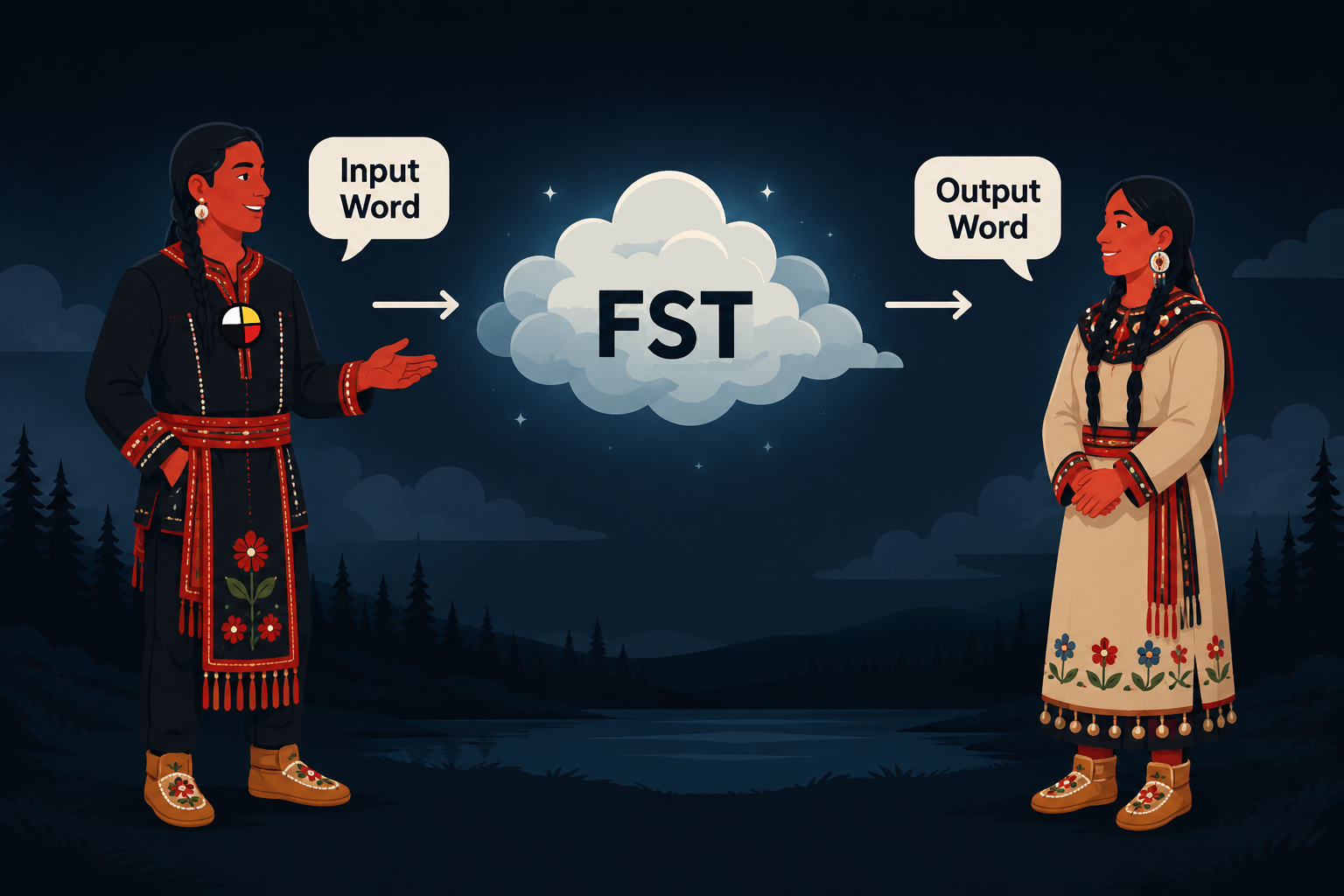
The Lightweight Heavyweight of Text Transformation
In software engineering, we are drowning in tools for processing text. We have regular expressions for pattern matching, relational databases for lookups, and modern Large Language Models (LLMs) for fluid text generation.
But when you need to transform text with 100% mathematical certainty, blistering speed, and minimal memory, there is a mature and battle-tested computer science technique that underpins modern search engines, spell-checkers, and computational linguistics: the Finite State Transducer (FST).
What is an FST?
To understand a Finite State Transducer, it helps to start with something familiar: a Finite State Automaton (FSA).
An FSA is a machine that reads an input string character by character. As it moves between internal “states,” it determines whether the string is valid or invalid. It answers a binary question: Does this match the pattern? (This is exactly how a compiled regular expression works under the hood.)
A Transducer (FST) adds a superpower to this machine: it generates an output while it reads the input. Instead of simply saying, “Yes, this word matches,” an FST maps an input string to an output string.
FSA: input → accept/reject
FST: input → transformed outputThe Anatomy of a Transition
In a standard state diagram, arrows connect circles (states). In a regular state machine, the arrow simply lists the required input character. In an FST, the arrow lists a pair:
Input:Output
If the machine is at State A, reads the character x,
it moves to State B and immediately outputs character y.
The Core Features: Why FSTs Are Unique
If FSTs simply map inputs to outputs, why not use a giant switch statement, dictionary lookup, or a series of regex replacements? FSTs possess several mathematical properties that make them exceptionally useful for large-scale text processing.
1. Linear-Time Performance (O(n))
Imagine maintaining 50,000 spelling correction rules. A traditional regex script might test a document against rule #1, then rule #2, then rule #3, and so on.
With FSTs, an operation known as composition allows thousands of independent rules to be mathematically combined into a single machine. When text passes through that machine, it is processed character-by-character exactly once.
Runtime depends primarily on the length of the input, not on the number of rules stored inside the transducer.
2. Bi-Directionality (Inversion)
Because an FST is a map of relationships (input:output),
it can often be inverted and run in reverse.
Generation:
Input:  cat + [plural]
Output: cats
Analysis:
Input:  cats
Output: cat + [plural]
A traditional regex or procedural function cannot usually be reversed automatically. The inverse parser often has to be written from scratch.
3. Compact Memory Footprint
FSTs rely heavily on structural sharing. If thousands of words share common prefixes, roots, or suffixes, those portions of the graph can be reused rather than duplicated.
As a result, dictionaries containing millions of possible word forms can often be compressed into remarkably small FST files.
Real-World Applications
Where do these machines actually appear in modern software?
| Industry | Application | How FSTs Are Used |
|---|---|---|
| Search Engines | Lucene / Elasticsearch | Store highly compressed term dictionaries for indexing, autocomplete, and fuzzy matching. |
| Speech & Audio | Text-to-Speech (TTS) | Normalize text such as “$5.00” → “five dollars” before speech generation. |
| Linguistics | Morphological Analysis | Analyze and generate complex word forms in highly inflected and polysynthetic languages. |

Summary for Developers
Think of an FST as regex search-and-replace on steroids: a compiled graph capable of representing and executing thousands of transformation rules simultaneously.
While modern generative AI excels at understanding context and ambiguity, it lacks strict determinism. Large language models can hallucinate and require substantial computational resources.
FSTs represent the opposite philosophy: architectural precision, zero hallucinations, and execution speeds measured in microseconds. When rules are absolute, an FST is often the ideal tool.
Why We Use FSTs for Anishinaabemowin
Languages such as English have relatively simple morphology. Anishinaabemowin, however, is highly polysynthetic, meaning a single word can often express information that would require an entire sentence in English.
A single word may encode information about person, number, tense, animacy, direction, and other grammatical features. Rather than storing every possible word form in a dictionary, an FST stores the rules that generate those forms.
makwa + plural
makwag
This allows a computer to:
- Generate valid word forms
- Analyze existing word forms
- Validate spellings
- Search by underlying morphology
All while remaining mathematically precise, memory efficient, and fast enough for real-world applications.